
Faunal Lists
The following bulk samples were collected by Dr. Laurie Anderson (South Dakota School of Mines) as part of her dissertation research on the evolutionary history of tropical American corbulid bivalves. In particular, these and other bulk samples allowed Dr. Anderson to reconstruct and better understand the ancient paleoenvironments in which these bivalves lived. The samples are from Neogene-aged deposits from Florida and the Atlantic Coastal Plain and continue to be used by Dr. Anderson’s graduate students to investigate new research questions. Research on these and other samples resulted in a number of publications, including those listed below.
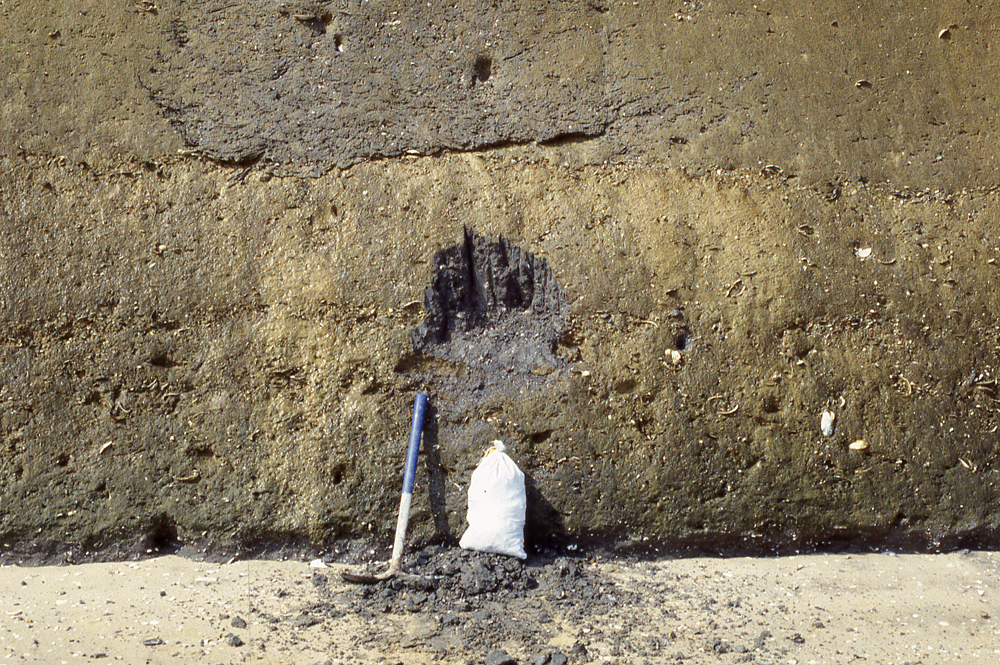
A bagged bulk sample collected from an exposure of the Pliocene Yorktown Formation of Virginia.
Miocene
Oak Grove Formation (Alum Bluff Group)
Pliocene
Duplin Formation
Georgia
Tamiami Formation (Pinecrest Beds)
Florida
Yorktown Formation (Morgarts Beach Member)
Virginia
Yorktown Formation (Moore House Member)
Virginia
Yorktown Formation (Rushmere Member)
Virginia
References
Anderson LC (2014) Relationships of internal shell features to chemosymbiosis, life position, and geometric constraints within the Lucinidae (Bivalvia). In: Hembree DI, Platt BF, Smith, JJ (eds.) Experimental Approaches to Understanding Fossil Organisms: Lessons from the Living. Springer, Topics in Geobiology 41:49-72.
Goodwin DH, Anderson LC, Roopnarine PD (2008) Evolutionary origins of novel conchologic Growth Patterns in Tropical American corbulid bivalves. Evolution and Development 10:643-656.
Anderson LC, Roopnarine PD (2005) Role of constraint and selection in the morphologic evolution of Caryocorbula (Mollusca: Corbulidae) from the Caribbean Neogene. Paleontologica Electronica 8.2.32A. (invited)
Anderson LC, Roopnarine PD (2003) Evolution and phylogenetic relationships of Neogene Corbulidae (Bivalvia; Myoidea) of tropical America. Journal of Paleontology 77:1086-1102. (Received best paper award for journal for 2003.)
Anderson LC (2001) Temporal and geographic size trends in Neogene Corbulidae (Bivalvia) of tropical America: Using environmental sensitivity to decipher causes of morphologic trends. Palaeogeography, Palaeoclimatology, Palaeoecology 166:101-120.
Anderson LC (1992) Naticid gastropod predation on corbulid bivalves: Effects of physical factors, morphological features, and statistical artifacts. Palaios 7:602-620.
Anderson LC, Geary DH, Nehm RH, Allmon WD (1991) A comparative study of naticid gastropod predation on Varicorbula caloosae and Chione cancellata, Plio-Pleistocene of Florida, U.S.A. Palaeogeography, Palaeoclimatology, Palaeoecology 85:29-46.